


Building Better Players: Matteo Masucci’s Vision for Youth Soccer Development in Los Angeles
What does it really take to develop a young soccer player—not simply to win the next match, but to build the technical ability, intelligence, resilience, and motivation needed for long-term success?
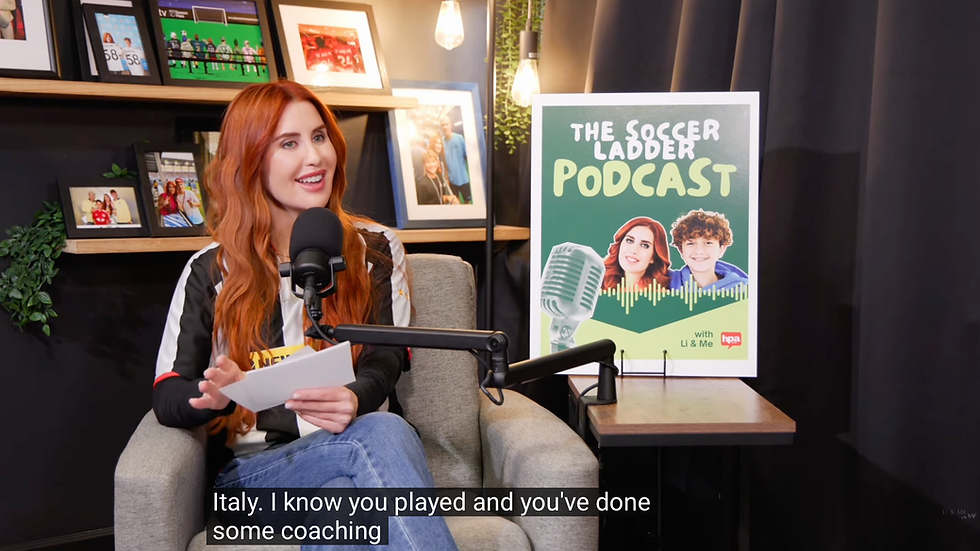
Matteo Masucci, General Manager of Juventus Academy Los Angeles, explored that question during a recent appearance on The Soccer Ladder with Li & Me. Drawing on his experience as a player, coach, sports scientist, academy leader, and technology founder, Masucci shared a development philosophy rooted in one central idea: winning should be the result of better players, not a substitute for developing them.
For families searching for high-quality youth soccer development in Los Angeles, the conversation offered a revealing look at how Juventus Academy LA approaches the game—and why the smallest details can make the greatest difference over time.
From Italy to Los Angeles: A Life Built Around Soccer
Masucci’s soccer journey began in Italy. Selected for a professional youth environment at 14, he moved away from home and learned far more than the game itself. Living with other young players taught him independence, responsibility, and the discipline required to pursue an ambitious goal.
After an ACL injury changed the direction of his playing career, he studied kinesiology, earned coaching qualifications, and began coaching at a young age. His curiosity eventually led him to study neuroscience and the connection between the brain, the body, decision-making, and performance.
That blend of European soccer experience, sports science, and coaching now shapes his work at Juventus Academy Los Angeles. His goal is not merely to identify talented players. It is to help develop them.
That distinction matters. Scouting can find a player who is already performing well. Development is the longer, more demanding process of helping a player acquire the tools to keep improving.
Player Development Comes Before the Scoreboard
Youth soccer naturally includes competition. Players want to win, coaches want their teams to perform, and families enjoy seeing results. But when winning becomes the only measure of progress, development can suffer.
Masucci explained that young players must first learn how to play the game correctly. That means teaching the details: receiving the ball cleanly, using both feet, controlling the ball under pressure, dribbling, passing with purpose, and finishing in different ways.
Shooting, for example, is not a single action. A complete player learns to finish with either foot, strike with the inside or outside of the foot, volley, shoot after a first touch, and create a shot after dribbling. Those variations require patient, intentional coaching.
At Juventus Academy LA, team success is viewed as the product of individual growth. When players become more capable, confident, and intelligent, the team becomes stronger as a natural consequence.
Why Technique Must Come Before Soccer IQ
Decision-making is one of the most valued qualities in modern soccer. Players must scan the field, recognize pressure, choose between passing and dribbling, and act in a fraction of a second.
But a correct decision has limited value if a player cannot execute it.
Consider a winger preparing to cross. The player may recognize the striker’s run and select the perfect moment to deliver the ball. If the cross lacks the right speed, height, or accuracy, however, the opportunity disappears.
This is why Masucci sees technique and soccer IQ as two connected phases of development. Young players first need enough repetition to make core movements increasingly automatic. As their touch, passing, and striking become more natural, they can devote more attention to reading the game and choosing the best action.
In simple terms: strong technique gives a player more time to think.
The progression also matches the changing formats of youth soccer. Smaller-sided games create frequent one-on-one situations and more touches on the ball. As players advance to 11v11, the number of teammates, opponents, spaces, and tactical choices increases dramatically. Technical confidence becomes the foundation for handling that complexity.
Ages 12–15: A Critical Window for Young Players
The years between 12 and 15 can be especially challenging. Players may grow rapidly, and sudden changes in height, strength, and body proportions can temporarily affect balance, coordination, speed, and confidence.
Masucci emphasized the difference between chronological age and biological development. Two players born in the same year may be at very different stages physically. A temporary advantage in size does not necessarily indicate greater long-term potential, just as a period of awkward movement does not mean a player has lost ability.
For coaches and parents, awareness is essential. Players need patience and appropriate training while they adjust to a changing body. Before and during growth spurts, consistent work on coordination and technique can give players a foundation they will carry into later years, when strength and power become more prominent.
This stage also includes the transition from smaller fields to 11v11. The space becomes much larger even though the player has not instantly become bigger, faster, or more experienced. Young athletes need time to understand new positions, greater distances, and more complex tactical responsibilities.
Progress is rarely a straight line. The right development environment recognizes that reality.
What the Modern Midfielder Needs
Masucci, himself a former midfielder, described the position as one of the most demanding and rewarding roles on the field.
The modern midfielder must contribute in possession, out of possession, and during transitions. The player needs the endurance to cover significant ground, the awareness to understand pressure arriving from every direction, and the technical security to protect and distribute the ball in crowded areas.
A strong midfielder must first avoid unnecessary turnovers. The best midfielders then add something decisive: a line-breaking pass, a through ball, an assist, or another action that changes the game.
For young midfielders, this means training more than passing patterns. They should develop scanning habits, body positioning, first-touch quality, comfort under pressure, defensive responsibility, and the courage to create opportunities.
Masucci pointed to Andrea Pirlo as a model of exceptional technique and intelligence, as well as Alessandro Del Piero for his ability to create goals for teammates in addition to scoring them. The lesson is not to copy a player’s style exactly, but to study how elite players see possibilities and make meaningful things happen.
The Parent’s Role: Observe Before You Overplan
Ambitious soccer parents usually act with good intentions. They arrange training, camps, teams, travel, and extra opportunities because they want to help their child succeed.
The danger, Masucci explained, is overplanning a child’s path so completely that the player’s own motivation has little room to grow.
Young athletes need support, structure, and guidance—but they also need ownership. Parents can learn a great deal by observing what a child chooses to do during free time. Does the player pick up a ball without being told? Ask to train? Watch games? Experiment with a skill?
Those choices reveal genuine interest. A sustainable development plan should respond to the player in front of you, not force that player into a rigid future designed too early.
For parents, the goal is not to become less supportive. It is to support in a way that strengthens internal motivation. Listen, observe, provide opportunities, and allow the player’s commitment to become visible through action.
The Most Practical Advice for a 13-Year-Old Who Dreams of Playing Professionally
Masucci’s advice was refreshingly simple: enjoy the game and spend more time with the ball.
Club training is important, but scheduled sessions alone are rarely enough to build exceptional comfort and creativity. Players can add valuable repetitions on their own with a ball, a wall, and a small amount of space. Passing against a wall, receiving with different surfaces, turning, juggling, dribbling, and striking can all become progressively more difficult as skill improves.
The purpose is not to turn every free hour into another formal session. Individual work should feel like exploration and play. When a young athlete genuinely enjoys spending time with the ball, improvement becomes more consistent and sustainable.
Masucci summarized the principle in a few words: “doing more than talking.”
For players ages 13–15, that daily relationship with the ball can create a major advantage. It builds confidence, expands technical options, and prepares the player to execute decisions when the game becomes faster.
Why One-on-One Ability and Finishing Still Matter
Modern teams rightly value possession, combination play, and collective organization. Yet Masucci believes youth development can sometimes place so much attention on team passing that individual attacking qualities receive too little training.
One-on-one ability gives players the power to break pressure and create an advantage when a passing lane is not available. Finishing turns those advantages into goals. Both require courage, creativity, repetition, and permission to make mistakes.
Developing individuals does not work against team soccer. It gives the team more solutions.
Technology as a Tool for Better Coaching
Masucci also discussed his work on a technology platform designed to help clubs understand what happens during day-to-day training. While many sports technologies measure physical outputs such as speed and distance, his approach focuses on coaching communication, teaching methods, feedback, and player context.
The aim is not to replace coaches with artificial intelligence. It is to give coaches, directors, players, and families more useful information. Better feedback can help an organization identify what a player needs now, coordinate the people supporting that player, and avoid losing valuable development time on the wrong priorities.
Used thoughtfully, technology can help human coaches become more consistent and informed while keeping the relationship between coach and player at the center.
Building Better Players in Los Angeles
The interview reflects the philosophy behind Juventus Academy Los Angeles: teach the game, develop the individual, and create an environment where ambition is supported by expertise and patience.
Young players need technical detail, intelligent challenges, physical awareness, and room to develop their own motivation. They also need coaches who understand that today’s result is only one moment in a much longer journey.
For families looking for a youth soccer academy in Los Angeles, the most important question is not simply, “How many games does this team win?” It is, “What is my child learning, and who are they becoming?”
At Juventus Academy LA, the work is designed to help players answer both questions with confidence.
Watch the full interview: Episode 36: Matteo Masucci—Building Better Players, Smarter Clubs & the Future of Soccer
Ready to take the next step? Request a tryout with Juventus Academy Los Angeles and learn more about our player-development programs in West LA, Chatsworth, and North Hollywood.


Sounds good. Time Duration Calculator
this is a thoughtful and detailed look at youth player development. the emphasis on technique before tactics, especially for the 12-15 age group, makes a lot of sense. it's refreshing to see a focus on long-term growth over short-term results. the point about the modern midfielder needing a complete skill set is particularly relevant. the advice for parents to observe and not overplan is practical and important. Lyrics Into Song